
Wheelchair Accessible Taxi Experts
Safe Journeys. Trusted Drivers. Every Time
Perth Wheelchair Taxi Solutions
The Chairs and the Trips We Carry Across Perth
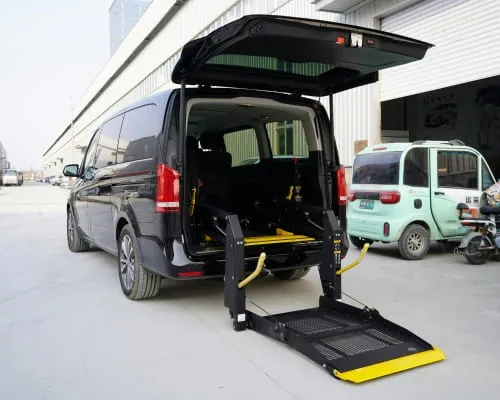
Manual chairs, powerchairs, tilt-in-space chairs and mobility scooters all travel with us, and each one is loaded and anchored slightly differently. Manual chairs are the most straightforward, though the occupant restraint still matters as much as the chair restraint. Powerchairs are heavier and need the ramp's safe working load checked against the chair weight, which is why we ask for a figure rather than an estimate. Tilt-in-space chairs are the ones most likely to be turned away elsewhere, because a reclined frame and a headrest push the seated height up towards the vehicle's internal clearance. Mobility scooters travel too, although the seating position means the restraint arrangement differs from a wheelchair. The trips themselves range from a three-kilometre run to a local medical centre through to a specialist appointment at Sir Charles Gairdner Hospital in Nedlands or a family event on the other side of the city. Whatever the chair and whatever the distance, the vehicle is booked for you specifically.
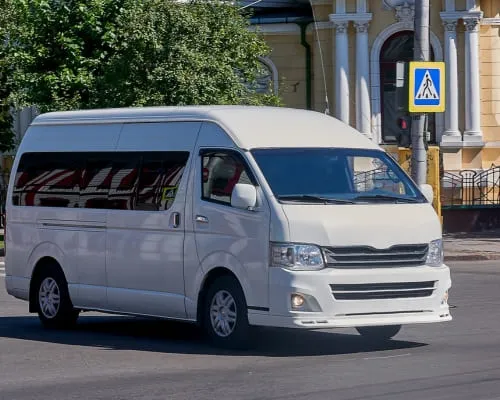
Perth Wheelchair Taxi Solutions
How We Load, Restrain and Move You Safely
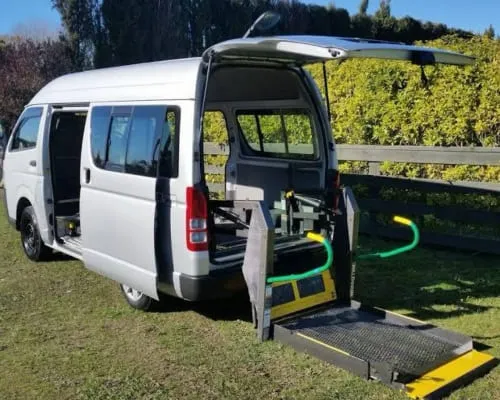
The loading sequence is fixed and it does not get shortened because somebody is running late. Your driver first finds a position with enough clear space to deploy the ramp or hoist properly, which in Perth's newer estates often means agreeing a spot away from a narrow single-width driveway or a verge full of parked cars. The ramp or hoist is deployed and locked, you board in your own chair, and the chair is then anchored at four separate points with tie-downs that stop any forward, rearward or lateral movement. Once the chair is secured you are fitted with a lap and sash belt, because the chair restraint and the occupant restraint do two different jobs and neither substitutes for the other. Only then does the vehicle move. Every driver working with Perth Wheelchair Taxi Solutions holds a current Western Australian passenger transport driver authorisation and must undergo special courses and trainings, which are reviewed and upgraded on a regular basis. The hoists and ramps themselves are treated by the Department of Transport as complex vehicle modifications requiring approval, so the equipment is documented rather than home-made.
Perth Wheelchair Taxi Solutions
Why Perth Passengers Book Us Instead of Taking Their Chances
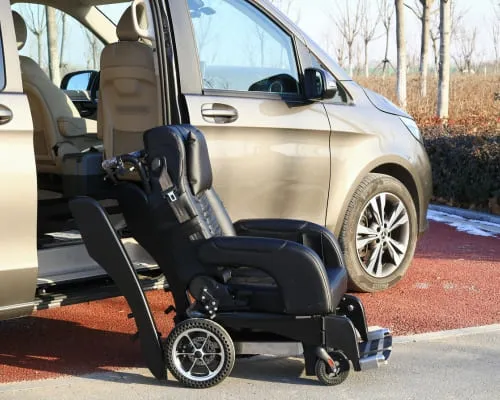
The complaint we hear most often is not about price, it is about a booking that was accepted and then abandoned. General taxi dispatch releases an accessible job to whichever driver claims it, which means the vehicle can be cancelled twenty minutes out and the passenger is left with a specialist appointment they will now miss by three months. We do the opposite: your booking is held against a specific vehicle and a specific driver, so the car that was promised is the car that turns up. Short local fares get taken rather than quietly ignored, which matters enormously if you live two kilometres from your GP and have been stranded before. Our drivers are background-checked and selected for temperament as much as skill, because talking over a passenger to their carer is a failure even if the vehicle arrives on time. We built the business after a decade in the industry precisely because these failures were routine, and more than 1,000 passengers later the operating rule has not changed. Call 0483 926 000 and speak to somebody local rather than an offshore call centre.
Perth Wheelchair Taxi Solutions
What a Wheelchair Accessible Taxi Costs in Perth
Metered trips are charged on the standard Western Australian on-demand rank or hail fare structure, and the subsidy is where the real number is decided. A purple PTSS card covers 75% of your fare up to a maximum $35 subsidy per trip when you are travelling seated in your wheelchair, which on a typical suburban run to an appointment removes most of the fare. A standard yellow PTSS card covers 50% up to $25. Paper TUSS vouchers stopped working on 1 October 2025, so if you are still holding vouchers you need to move to the PTSS card before your next trip. For private hourly bookings such as extended outings or multi-stop days, published market rates for an accessible vehicle in this part of Perth sit around $45 to $65 per hour on weekdays, with evenings and weekends higher, and we quote your specific booking rather than working from a table. NDIS participants using provider travel can be charged up to $2.76 per kilometre for a modified accessible vehicle under the 2026-27 pricing arrangements. Call 0483 926 000 and we will price the actual trip before you commit.
Perth Wheelchair Taxi Solutions
Wheelchair Taxi, Rideshare, Community Transport or Patient Transport
These four options get confused constantly and choosing wrongly costs people appointments. A wheelchair accessible taxi is on-demand, comes to you, and lets you stay in your chair with proper restraints, which makes it the right answer for appointments, outings and anything time-sensitive. Rideshare is cheap and plentiful but the vehicles have no ramp, no hoist and no tie-down points, so it only works if you can transfer to a car seat and your chair folds into a boot. Community transport is genuinely valuable and often cheaper, but it runs to a roster with fixed routes and days, so it suits a regular shopping trip far better than a Thursday afternoon specialist appointment that was scheduled last week. Non-emergency patient transport is a clinical service with trained medical staff on board, and if your transfer needs supervision or monitoring in transit that is what you need, not a taxi. Our honest position is simple: if community transport covers your trip and you are not in a hurry, use it. If you need to stay in your chair, leave when you choose and arrive on time, book us on 0483 926 000.
Related Services
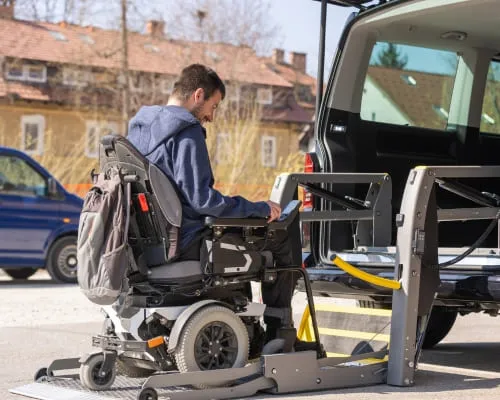
Stay in your own chair, anchored on four-point tie-downs, from your front door to the destination door. Certified ramps and hoists, drivers held to the national wheelchair-restraint competency, and a vehicle reserved for your booking rather than dispatched from the nearest rank.
For passengers who need patience more than they need a ramp. A held booking, a driver who walks you to the door instead of the kerb, and PTSS processed on the spot, whether or not you travel seated in a wheelchair.

Transport that clears your plan manager first time. Self-managed and plan-managed participants handled, itemised to the line, with standing weekly bookings for work, study, therapy and day programmes in a wheelchair accessible vehicle with certified ramps and restraints.
TESTIMONIALS
What Our Wheelchair Accessible Taxi Customers Say About Us
The Process
3 Step Process For Your Wheelchair Accessible Taxi Needs

Book Ahead
Call or message with your pickup, destination and chair type. We confirm the vehicle, driver and arrival window before you hang up.

We Arrive
Your driver arrives inside the agreed window, checks the access route, then loads and secures your chair with four-point restraints before moving.

Safe Arrival
We take you right to the door, not the kerb, and wait or return for you if your booking includes it.
Wheelchair Accessible Taxi In Perth
FREQUENTLY ASKED QUESTIONS
Everything you need to know about our Wheelchair Accessible Taxi In Perth
Are wheelchair taxis more expensive than a standard taxi?
The base fare structure is the same, and the difference most passengers actually notice is the subsidy working in their favour rather than a loading working against them. If you hold a purple PTSS card and travel seated in your wheelchair, the Passenger Transport Subsidy Scheme covers 75% of the fare up to a $35 subsidy per trip, which is a more generous rate than the 50% and $25 cap that applies to a standard yellow card. Where the cost genuinely does differ is on longer private bookings, because an accessible vehicle costs more to run and to maintain than a sedan. We quote before you travel so the number is settled in advance. Call 0483 926 000 and describe the trip.
How far ahead do I need to book a wheelchair accessible taxi in Perth?
Same-day trips are often possible, particularly outside the morning and mid-afternoon appointment peaks. Anything time-critical is worth booking further ahead, and specialist appointments, day surgery and hospital discharges are the ones people most often leave too late. If you travel to the same place each week, ask for a standing booking and the slot is held for you permanently. We will tell you honestly if a requested time is already committed rather than accept it and hope. Call 0483 926 000 and we will confirm availability while you are on the phone.
Can you put a wheelchair in a taxi safely?
In a purpose-built wheelchair accessible vehicle, yes, and the standard is stricter than most passengers realise. Your chair is loaded via a certified ramp or hoist, then anchored at four separate points so it cannot move, roll or tip in transit. You are then given a lap and sash belt of your own, because the chair restraint holds the chair and the occupant restraint holds you. In Western Australia the hoists and ramps themselves are classed as complex vehicle modifications that require departmental approval, so the equipment is inspected rather than improvised. A standard sedan or a rideshare car has none of this, which is why a folded chair in a boot is a completely different proposition.
What actually happens when the taxi arrives?
Your driver parks with enough clear space behind or beside the vehicle to deploy the ramp, which sometimes means agreeing a spot slightly away from a narrow verge or a tight cul-de-sac head. They come to you rather than waiting at the kerb and sounding the horn. The ramp or hoist goes down, you board in your own chair, and the driver anchors the four tie-down points and fits your lap and sash belt before the vehicle moves. At the other end the process runs in reverse and you are taken to the actual door, whether that is a hospital reception desk, a clinic waiting room or your own hallway. Nothing gets rushed because the booking was held for you rather than squeezed between two other jobs.
What if my powerchair is too tall or too heavy for the ramp?
This is the single most common surprise in accessible transport, and it is entirely avoidable. Tall backrests, headrests and tilt-in-space frames can put your seated height close to a vehicle's internal clearance, and heavy powerchairs can approach the ramp's safe working load. Tell us the approximate width, length, seated height and weight when you first book and we will confirm the fit before the vehicle is dispatched rather than after it arrives. We record your measurements against your name so every future booking automatically goes out with the right vehicle. If your chair is an unusual shape, send a photo with a tape measure in the frame.
How many people can go in a wheelchair taxi, and should I book a maxi instead?
One wheelchair passenger plus accompanying seated passengers is the standard configuration, and how many extra seats you get depends on which vehicle is rostered and whether one or two chairs are travelling. A carer, family member or support worker travels alongside you in a normal seat, so tell us the numbers at booking and the fare is quoted with everyone included. If two wheelchair passengers need to travel together, ask and we will tell you honestly whether that works in one vehicle or needs two. Larger group bookings where nobody is travelling in a wheelchair are usually better served by a standard maxi taxi, and we will say so rather than sell you a service you do not need. Call 0483 926 000 and describe who is travelling.
Request A Free Wheelchair Accessible Taxi Quote
Contact us
BUSINESS
SERVICES
OPERATING HOURS
Sun: 24 hr
Mon: 24 hr
Tue: 24 hr
Wed: 24 hr
Thu: 24 hr
Fri: 24 hr
Sat: 24 hr
ABN 93 178 937 861