
Reliable Wheelchair Accessible Taxis Across Morley and Beyond
Safe Journeys. Trusted Drivers. Every Time
Wheelchair Accessible Transport in Morley
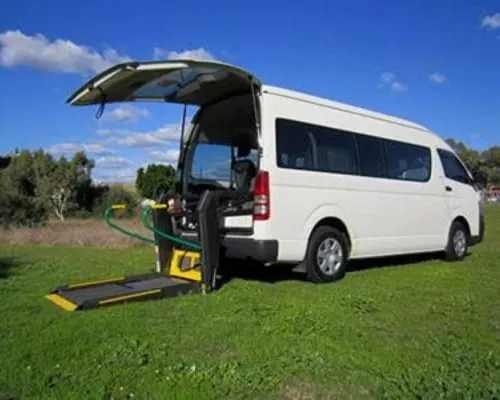
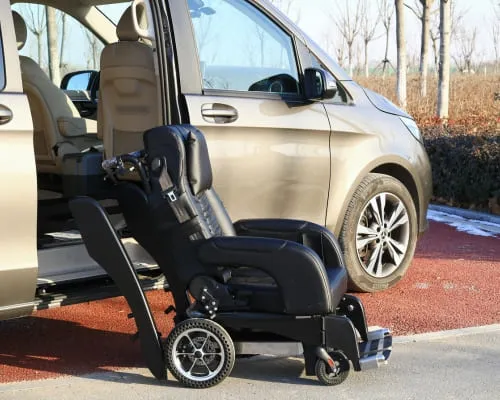
Finding comfortable, safe, and dependable disability transport shouldn't be a challenge. Whether you are scheduling a vital medical appointment, heading out for a social event, or managing your daily routine, our premium wheelchair accessible taxi service in Morley is here to get you there with complete peace of mind. We take pride in delivering a specialised transport experience that prioritises your comfort, dignity, and independence every single step of the way. Our purpose-built, fully accredited WAVs (Wheelchair accessible vehicles) are meticulously equipped with advanced hydraulic hoists, and secure four-point restraint systems, ensuring a smooth ride without ever requiring you to transfer out of your wheelchair.
At the heart of our service is a dedicated team of professionally trained, empathetic drivers who understand the nuances of assisted travel. Serving Morley and the surrounding communities north of the river, we provide unmatched local expertise and exceptional punctuality. We believe that premium specialised transit should remain highly affordable, which is why we offer completely transparent pricing and zero hidden fees. For a seamless experience, our drivers can scan your WA Government Passenger Transport Subsidy Scheme (PTSS) smart card right inside the vehicle on the spot, and we gladly accept Cabcharge alongside all major credit cards. Experience the difference of a local transport provider that truly cares - use our banner form above to secure your Morley accessible taxi booking today.
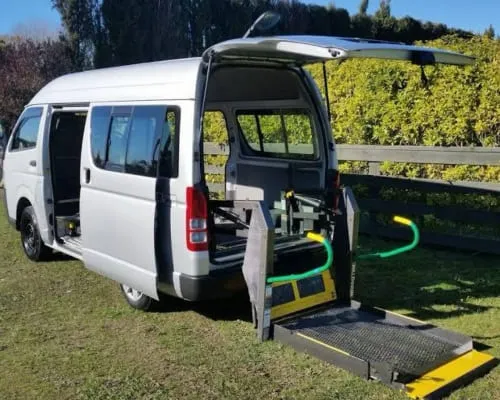
Stay in your own chair, anchored on four-point tie-downs, from your front door to the destination door. Certified ramps and hoists, drivers held to the national wheelchair-restraint competency, and a vehicle reserved for your booking rather than dispatched from the nearest rank.
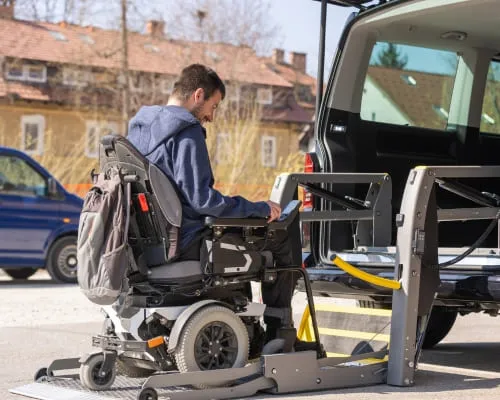
For passengers who need patience more than they need a ramp. A held booking, a driver who walks you to the door instead of the kerb, and PTSS processed on the spot, whether or not you travel seated in a wheelchair.
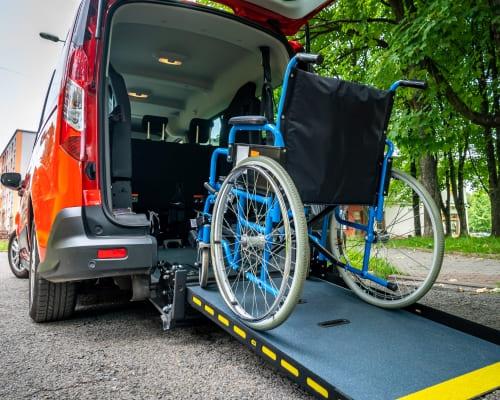
Transport that clears your plan manager first time. Self-managed and plan-managed participants handled, itemised to the line, with standing weekly bookings for work, study, therapy and day programmes in a wheelchair accessible vehicle with certified ramps and restraints.
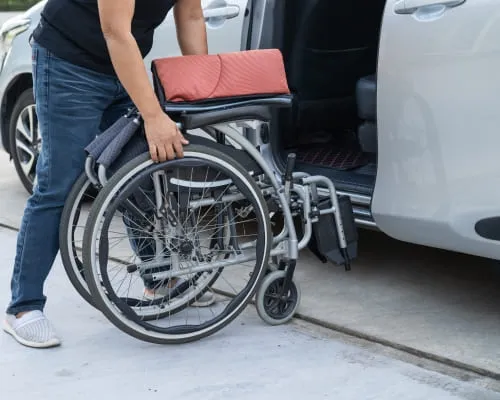
Booked around the appointment time, not the traffic. Agreed meeting points at Sir Charles Gairdner, St John of God Subiaco and Midland, Joondalup Health Campus and Osborne Park Hospital, with your chair secured properly and a driver who waits when discharge runs late.
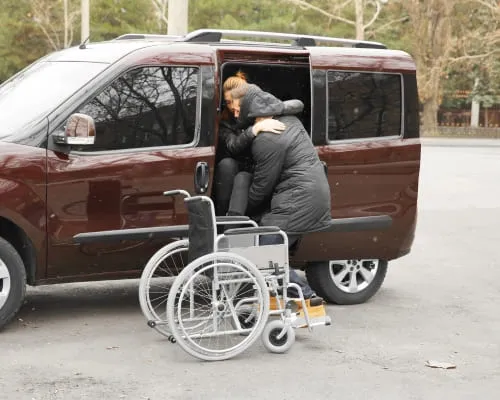
The same driver, the same time, every week, so getting to therapy stops being the hard part of therapy. Standing bookings to physiotherapy, occupational therapy, hydrotherapy and day programmes across Perth, set up once and never rebooked again.
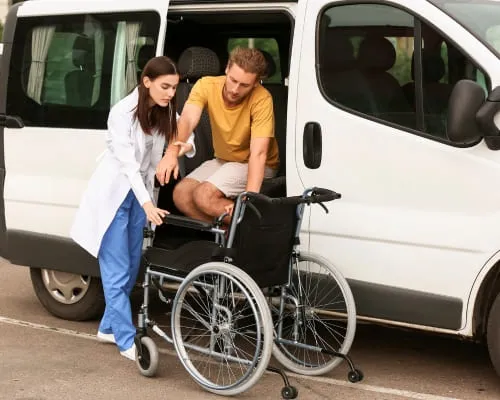
Door through door, not kerb to kerb. An arm down the front steps, the shopping carried in, and a driver who has allowed enough time that nobody has to hurry, whether you use a walking frame or a powerchair.
OUR STORY
Rail Arrived. Door-to-Door Did Not.
On 8 December 2024 the Ellenbrook Line opened with stations at Morley, Noranda, Ballajura, Whiteman Park and Ellenbrook, a twenty-one kilometre project and the largest expansion of Perth's rail network in more than sixteen years. It has been genuinely transformative for this corridor, and we would be the first to tell an independent traveller to use it. The reason our phone still rings from streets within easy reach of the station is that a railway is designed to solve the middle of a journey, and our passengers' problem lives at the ends. Getting from a post-war front entry with four steps and no handrail down to a footpath is the barrier.
Crossing a station concourse and then covering the last stretch from a station exit to a clinic reception desk is the barrier. Trains do neither, and no amount of new infrastructure changes it. That gap between a station and a front door is the whole reason disability taxi work exists in a suburb that is now well served by rail. Call 0483 926 000.
HOW WE WORK IN Morley
Post-War Houses and Arterial Frontages
Morley presents two distinct obstacles, and they compound each other. The first is the housing, which is largely post-war stock from the 1950s and 1960s: three or four steps to a front entry, a handrail on one side if you are fortunate, side access too narrow to bring a chair around, and no ramp retrofitted because nothing about the original design anticipated one. Crossovers were poured for the family sedans of the period and are narrower and often steeper than a long-wheelbase vehicle with a deployed rear ramp requires.
The second obstacle is traffic, because Morley is a substantial commercial centre and several of its residential pockets sit against arterial roads carrying heavy, continuous flow. A rear ramp needs clear level ground behind the vehicle, and setting one down into a live traffic lane is not a risk we will take with a passenger in a chair, no matter how close to the front door it would be. The practical answer is to find a quieter approach, and in this suburb that is usually a side street, a driveway with genuine room behind it, or a rear laneway where the block has one.
All of it is decided before the day and stored against the address. For anything ongoing, aged care transport here works best as a standing weekly booking.
Why choose us in Morley
Why Morley Households Book Us
The failure our Morley passengers describe most often is the short-fare brush-off, where a three-kilometre trip to a GP is accepted and then quietly displaced by something more profitable. Because our bookings are committed to a specific vehicle and driver rather than auctioned into a dispatch pool, there is no mechanism by which yours gets dropped, and a short local run is treated exactly like a long one. Drivers are selected for temperament as deliberately as for skill, which matters enormously to older passengers who have been spoken over, hurried, or treated as freight by somebody in a rush. Every driver holds a current Western Australian passenger transport driver authorisation, is background-checked, and must undergo special courses and trainings, which are reviewed and upgraded on a regular basis.
Our vehicles carry certified ramp and hoist systems with four-point tie-downs, and those modifications require Department of Transport approval, so the equipment is documented rather than improvised. PTSS cards are processed at the end of the trip. Call 0483 926 000.
AREAS WE COVER IN Morley
The Morley Streets We Serve
Our work here follows the split between quiet residential pockets and busy frontages. The interior streets of Morley's post-war areas are straightforward once the entry is known, and they are where most of our medical appointment transport pickups happen, with the loading point usually on the crossover or immediately in front of the house. The addresses fronting or feeding directly onto the arterial roads are the ones we approach differently, nominating a side street or a laneway rather than the frontage itself.
The streets around the station generate a surprising volume of bookings, precisely because proximity to a platform does nothing for somebody who cannot reach it. Morley runs into Dianella and Yokine without any real break, and since Dianella was assembled in 1958 from localities including Morley Park, trips between the three are constant rather than occasional. If your street sits on one of those boundaries, call 0483 926 000 and we will confirm.
Wheelchair Accessible Transport In Morley
FREQUENTLY ASKED QUESTIONS
Everything you need to know about our Wheelchair Accessible Transport In Morley
What does a wheelchair taxi cost in Morley?
Trips are metered on the standard Western Australian on-demand fare structure, then the PTSS subsidy is applied by the driver at the end of the journey. A purple wheelchair card covers 75% of the fare up to a $35 subsidy per trip and a yellow card covers 50% up to $25. Morley is well placed for short runs, whether that is a local GP, a pharmacy or across to Osborne Park Hospital, and on those the subsidy usually leaves a small gap rather than a real fare. If you are still holding paper TUSS vouchers they stopped being accepted on 1 October 2025 and you will need the card.
The Ellenbrook Line opened at Morley. Why would I still book a taxi?
Because a railway solves the middle of a journey and leaves both ends untouched. The line opened on 8 December 2024 with five stations, and for anyone who can independently reach a platform and manage the walk at the far end it is cheaper than we are and we will say so. What it cannot do is get somebody down four post-war front steps, along a footpath with lifted slabs, and from a distant station entrance to a clinic reception desk. Those few hundred metres at each end are precisely where a powerchair, a walking frame or low vision decides the outcome, which is why we still get steady bookings from streets close to the line.
My mother's house is on a busy road. Can you still collect her?
We can, and we will almost certainly do it from somewhere other than the frontage. Several of Morley's residential streets feed directly onto arterial roads carrying constant traffic, and deploying a rear ramp into a live traffic lane is not something we are prepared to do regardless of how convenient it looks. The usual answer is a quieter side street, a driveway where there is room behind the vehicle, or a rear laneway where one exists. We work this out at the first booking and record it, so it is decided once rather than improvised each time.
Can you help with high front steps on an older Morley home?
That is a large part of the job in this suburb. Morley's post-war stock commonly has three or four steps up to a front entry, a handrail on one side at best, narrow side access and no ramp ever fitted, because nobody was planning for a walking frame when these homes were built. Your driver comes to the door, offers an arm or steadies the frame, stows it properly and sees the passenger into the vehicle without hurrying them. A physical lift or a hoist transfer inside the home is not something we do, as that is a manual handling task for a support worker or an occupational therapist to arrange.
Which hospitals do you run to from Morley?
Osborne Park Hospital, with its stroke rehabilitation inpatient services and its aged care and rehabilitation work, is a short and frequent run west. St John of God Midland Public and Private Hospitals, which opened in November 2015, is a comfortable trip east and takes a good deal of the eastern corridor's outpatient work. Sir Charles Gairdner Hospital in Nedlands, which shares a campus with Perth Children's Hospital, is a longer inbound run for specialist appointments and needs an early departure for a morning clinic. We book backwards from the appointment and add your real loading time.
Do you cover Noranda, Bayswater, Dianella and Yokine as well?
Dianella and Yokine are both on our regular list and sit directly against Morley, so our vehicles cross between these suburbs continuously, and Dianella was itself formed in 1958 partly out of Morley Park, which tells you how notional the boundaries are here. The list on this site reflects where we work most often rather than a hard edge. If your address is nearby and not named, call 0483 926 000 and we will confirm on the spot.
TESTIMONIALS
What Morley customers Say About Us
Contact us
BUSINESS
SERVICES
OPERATING HOURS
Sun: 24 hr
Mon: 24 hr
Tue: 24 hr
Wed: 24 hr
Thu: 24 hr
Fri: 24 hr
Sat: 24 hr
ABN 93 178 937 861